Congrats. Your AI Built a B- Strategy. It’s Not Investable
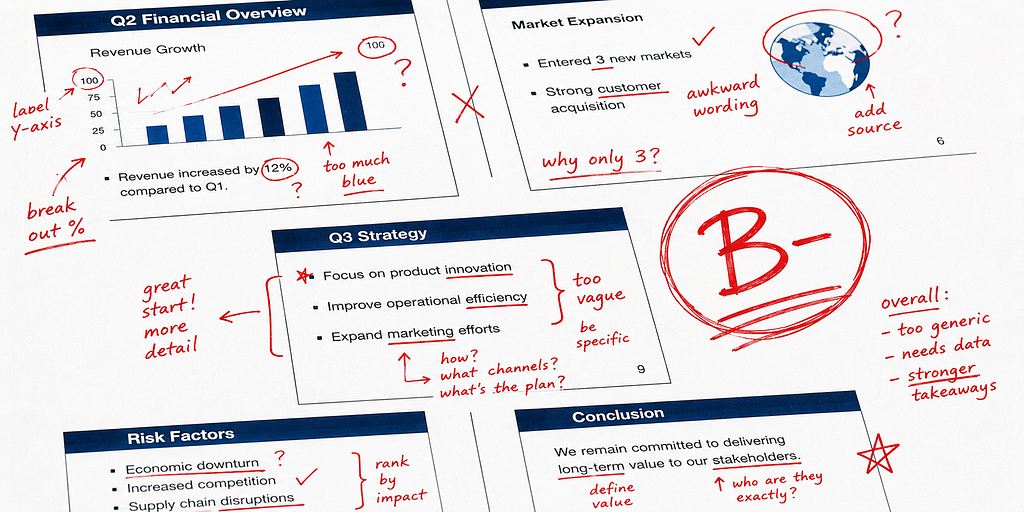
I read a lot of output. Decks, PRDs, whitepapers, memos, strategy documents. And I can tell within two paragraphs whether someone actually thought about the problem — or typed a prompt, liked what came back, and hit send.
The banal output has a texture. It covers the right topics without saying anything about them. The structure is there, the logic is approximate, the recommendations are safe. Nothing wrong enough to argue with. Nothing right enough to act on. A B-. Technically passing. Not investable.
It is the strategy equivalent of a stock photo.
What frustrates me is not the tool — I use AI constantly. For cutting data, writing code, processing information, it is excellent. What frustrates me is the moment someone decides that producing output is the same as doing the work.
I learned to frame arguments over many years and a lot of difficult feedback. Not softened feedback. The kind where someone more senior takes apart something you were proud of and shows you exactly where the logic broke. You make the same mistakes repeatedly until you understand why they are mistakes — not just that they are. That process is slow and painful and there is no shortcut through it.
AI removes that process entirely. It gives you a passing grade without the failure that teaches you why.
And that is what makes apprenticeship more important now, not less. The standard that makes self-correction possible has to be built first — and it gets built through proximity to someone better than you, doing real work, getting it wrong in rooms that mattered. That transmission does not happen through a prompt. It happens through a relationship. Which means you have to ask for it. The questions you ask your manager are more important than the prompts you put into Claude. One builds judgment. The other performs it.
And occasionally — not often — someone puts something in front of me where I can feel the thinking. A framing I had not considered. A question that reorients the whole problem. Something that solves the actual problem rather than the stated one. No preamble, no hedging. Just someone who understood the situation well enough to say something true about it.
That is immediately obvious. And it is getting rarer.
Which brings me to the career risk nobody is naming directly. When I receive work that needs fundamental logical correction, I have a choice. I can take the time to explain what the argument should have been, where the framing broke, what was never asked. Or I can close the laptop and prompt it myself in ten minutes.
Increasingly, I choose the second. Not out of frustration — out of time. And the person on the other end often does not realize that the feedback stopping is not a good sign. It means the loop that would have built their judgment quietly closed.
The only protection against that is learning to self-correct. Reading your own output as a demanding senior would before you send it. Building the internal standard the tool will never build for you. Because if you cannot tell the difference between B- thinking and something genuinely worth acting on, neither will the work you produce.
The noise floor went up. Average output looks better than it ever has. Which means the gap between average and actually good thinking is easier to spot now, not harder. Original thinking is scarcer. And scarcity changes the price.
The people building real judgment right now are becoming indispensable in a way they probably do not fully appreciate yet. The people who are not are producing very polished work that nobody is going to act on.
And wondering why the feedback stopped coming.